
CRL Solutions Consulting

Disrupting Advanced Material Qualification

CRL Solutions Website QR Code

We Have Solved the High-Temperature Metals Qualification Bottleneck.

Our coefficient-free, nonlinear damage summation model reliably predicts creep-rupture life beyond 10 years from just a few weeks of testing.

Core Features

Empirical Coefficient-Free Model

Functions entirely without pre-set empirical constants or material assumptions, avoiding standard curve-fitting vulnerabilities.

Unmatched Extrapolation Power

Reliably projects long-term creep-rupture life up to two orders of magnitude beyond maximum test times.

Testing Time & Cost Reduction

Requires a minimum of 3 short-term stress-time pairs at constant temperature, eliminating years of expensive furnace time.

Algorithmic Objectivity

Generates regressions for median and low-probability survival bounds, removing human subjectivity.

Predictive Mechanism Awareness

Utilizes non-linear kinetics to mathematically identify material mechanism shifts ("slope breaks").

Validated against NIMS

Rigorously validated against independent, long-term National Institute for Materials Science data sheets.

Applications

1. Accelerated Time-to-Market

Reduce furnace testing time for standard high-temperature metals from years to months.

3. Advanced Manufacturing

Enable rapid material screening to weed out defective alloy variations early in production.

2. ICME Integration Ready

Generate structural damage constants instantly, feeding objective data into engineering simulation platforms.

4. High-Temperature Component Lifing

Assess the remaining safe life of aging power plants and aerospace engines.
Strategic Upside Opportunities: Advanced SMRs & RHEAs • Additive & In-Space Manufacturing • A.I. Material Discovery Data
CRL Solutions Consulting

Disrupting Advanced Material Qualification

CRL Solutions Website QR Code
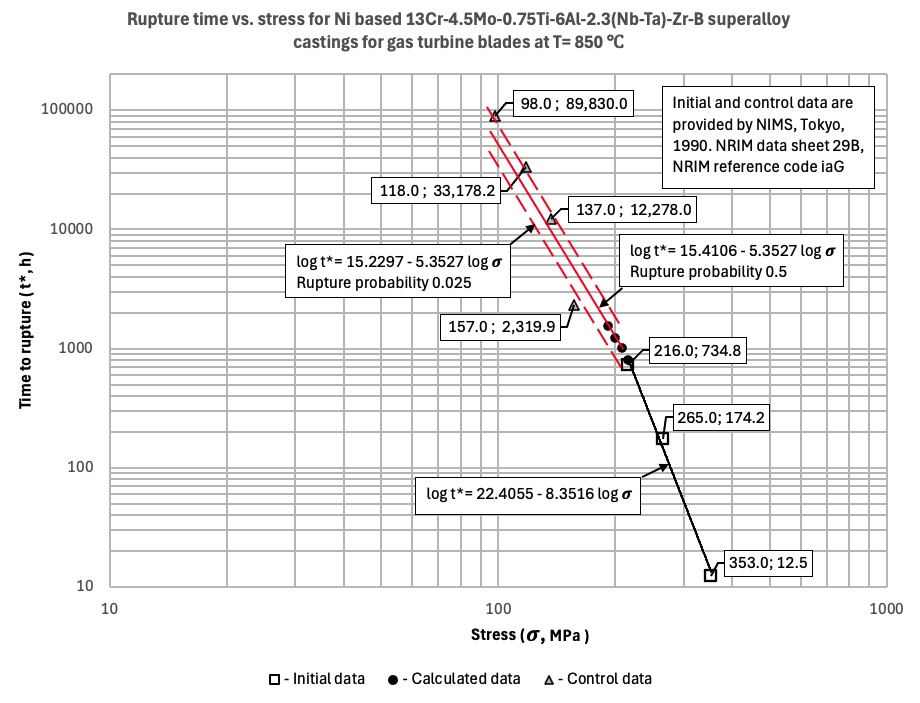
CRL Solutions Chart

The graph above demonstrates our Nonlinear Damage Summation methodology in action on a Ni-based superalloy.

  • The Input: We fed our algorithm strictly short-term furnace data, representing less than one month of testing (max 734.8 hours).
  • The Prediction: Without using any pre-set empirical coefficients, our model projected the material's failure trajectory for both the median rupture probability (p ≈ 0.5) and the low-probability survival bounds (p ≈ 0.025).
  • Our 30-day algorithmic prediction perfectly aligned with independent, 10-year control data (89,830 hours) provided by NIMS.

Zero-Risk Blind Validation

Step 1: The Input

Provide three or more short-term stress-time (σ-t*) test pairs at a constant temperature.

Step 2: The Withhold

Withhold all corresponding long-term rupture data and material class.

Step 3: The Reveal

We deliver reliable, long-term rupture projections alongside statistical survival bounds.

CRL Solutions Consulting

Disrupting Advanced Material Qualification

CRL Solutions Website QR Code

Proven Versatility: Up to 199x Extrapolation Across Diverse Alloy Classes

A truly disruptive prediction engine cannot rely on material-specific curve-fitting. Using short-term furnace data (1 to 4.9 months), our algorithm successfully predicted independent, long-term NIMS control data spanning up to 36 years.

Material Class Testing Input
(Short-Term)*
Verified Prediction
(Independent)**
Extrapolation Power
Ni superalloy 1.0 Months 10.3 Years 122x
1Cr-0.5Mo steel 3.7 Months 23.5 Years 76x
0.2C silicon-killed 3.1 Months 28.5 Years 109x
18Cr-10Ni-Ti SS 1.4 Months 22.9 Years 191x
Fe superalloy 1.3 Months 15.7 Years 145x
18Cr-8Ni SS 4.9 Months 20.5 Years 50x
11Cr-2W SS 2.3 Months 10.9 Years 57x
2.25Cr-1Mo steel 2.1 Months 35.3 Years 199x
18Cr-12Ni-Mo SS 2.9 Months 36.6 Years 151x
9Cr-1Mo-V-Nb 1.3 Months 11.6 Years 105x

Data Source: Extrapolation verified against independent, long-term National Institute for Materials Science (NIMS) data sheets.

* Input calculated at standard ~730 hours per month.
** Control calculated at standard 8,760 hours per year.